Categories
Dracula

Dracula Probably Had Syphilis

By Hanna Jennings

Old wooden operating tables, undrinkable and contaminated water, doctors with unsterilized equipment in a case lined with velvet, operating rooms with over eighty students watching, sewers exploding from a build-up of methane gas, accidental carbolic acid poisoning from trying to eradicate the germs that lurked out of sight, invasive procedures, and violating exams were no nightmare, but rather were just standard public health in London during the mid-nineteenth century. In just the span of thirty years, London’s understanding of infectious disease and public health would change the city dramatically. By 1875, London had a fully functioning sewer system, and by 1880 the Germ Theory of Disease was beginning to be more widely accepted. With the public’s new understanding of the “unseen” germs, several disease pandemics, the recent invention of carbolic acid soap, and a legislation more concerned with public health, the perfect stage was set in 1897 for Bram Stoker’s Dracula. With the fear of disease at an all-time high, Dracula comes to represent the unseen force or germ that moves effortless through London’s streets, silently spreading his contagion much like London’s previous outbreaks of cholera and syphilis. Dracula’s ability to infect and spread amongst any individual, regardless of class, is similar to the cholera outbreaks that affected Londoners of all economic backgrounds; the threat of syphilis mirrored the threat of more sexually liberated women, as Dracula was published on the cusp of feminism in London in response to the Contagious Disease Acts. In order to maintain the elevated and scientific society Stoker portrays London as in Dracula, the corruption and impurity which arises from foreign threats such as contagion must be eradicated.

Two major pandemics which lead to some of the most drastic changes in London were the Broad Street cholera outbreak and the ongoing, unregulated syphilis outbreak that had been haunting London for years. The 1854 Broad Street cholera outbreak began when a water pipe was constructed next to the river banks where London’s untreated human waste and industrial pollution was dumped in to the river human waste and industrial pollution was dumped in to the river Thames. This was one of the last severe cholera outbreaks, but by 1854, cholera had already claimed over fifty-two thousand lives.

Wellcome Collection, 1831.

Fatality rates aside, the emergence of an infectious disease with the symptoms of cholera was visibly terrifying as well. Cholera’s symptoms included severe loss of skin elasticity, hypertension, severe emesis, lethargy, and episodes of copious, explosive watery diarrhea. The disease was very physical, with the appearance of infected individuals changing drastically in a short period of time, as shown with the illustration from the Wellcome Collection of the physical differences between a young female patient before she was infected, and shortly thereafter. The drastic physical changes earned cholera the title of the Blue Plague, as infected individuals lips and skin would turn gray-blue due to a loss of fluids. The physical changes and the smell helped people to visualize how fast the disease could spread during an outbreak, and how fatal the disease was. However, it wasn’t until the outbreak on Baker Street when John Snow discovered that cholera spread through “germ” infested waters instead of miasma, a now obsolete medical theory which upheld that disease was spread by foul smelling air.

London’s rapid increase of population and industrialization, combined with abysmal excrement disposal is an environmental pollution frequently alluded to in Dracula. Dracula is described as traveling within a “white mist,” and his presence has some sort of influence over the mist that surrounds himself. The night Dracula first arrives in Whitby, the old sailor, who had told stories to Mina, sensed his impending doom and Dracula’s presence by the taste and smell of the early storm’s air: “Look! Look! He cried suddenly. ‘There’s something in that wind and in the hoast beyont that sounds, and looks, and tastes, and smells like death. It’s in the air. I feel it comin” (108). The smell of death overtaking the city is not something that would be foreign to Londoners, especially following the Great Stink of 1858 when the hot weather severely exacerbated the smell of untreated fecal waste in the River Thames.

Upon entering the Chapel where Dracula had been hiding his dirt, Johnathan recounts the smell of the air: “The long disuse had made the air stagnant and foul. There was an earthy smell, as of some dry miasma, which came through the fouler air. . .It was not alone that it was composed of all the ills of mortality and with the pungent, acrid smell of blood, but it seemed as though corruption had become itself corrupt” (358-359). This horrible stench that clung to the Chapel originated from “every breath exhaled by that monster” (359); Stoker uses this sense to inform the audience that Dracula is so contagious, even entering a space he has resided in puts the individual at risk of contagion. Johnathan notes that the smell was so horrible that, under any other circumstances, the group would have left, but because their purpose was so important, they had: “a strength which rose above merely physical considerations” (359). This miasma of Dracula was the onset of the vampiric disease, a disease that can be best understood when comparing it to London’s syphilis outbreak in the nineteenth century.

Syphilis and the spread of venereal diseases were of grave concern in London, in terms of both the public’s health and the conventional morality. In an effort to stop the spread of syphilis, the 1864’s Contagious Disease Act allowed for military and police to arrest women they suspected were prostitutes, and subject them to extensive medical examinations. These examinations, as recounted by Josephine Butler, were truly horrific: “It is such awful work; the attitude they push us into first is so disgusting and so painful, and then these monstrous instruments,—often they use several. They seem to tear the passage open first with their hands, and examine us, and then they thrust in instruments, and they pull them out and push them in, and they turn and twist them about; and if you cry out they stifle you with a towel over your face. . .you feel the instruments pressing up to your stomach, making you quite sick, they push them up so far” (Butler, 22). The horrors of these involuntary examinations did not end there, however. If a woman was found to be infected, she was confined to a hospital for three months to over a year.

The Contagious Disease Acts were created as a way to monitor the perceived betrayal of the Victorian female ideal, and in Dracula, Lucy embodies the betrayal of the ideal with her assumed impurity and promiscuousness. As readers, we quickly learn that Lucy is a more sexually liberated woman when she reflects on her three marriage proposals: “Why can’t they let a girl marry three men, or as many as want her, and save all this trouble? But this is heresy, and I must not say it” (87). Her temperament, unlike Mina’s more traditional values, is what makes her vulnerable to Dracula’s advances and ultimately leads to her infection. Throughout Dracula, Lucy’s battle with vampirism improves and worsens, but constantly bears a striking resemblance to someone with a very serious and untreated case of syphilis. Lucy’s symptoms, several characters note, include malaise, sore throat, and difficulty breathing: “She was ghastly, chalkily pale. The red seemed to have gone even from her lips and gums, and the bones of her face stood out prominently. Her breathing was painful to see or hear” (173). Similarly, some of the most common symptoms of syphilis include fever, fatigue, sore throat, and weight loss. As her condition worsened, her gums began to recede: “The gums seemed to have shrunken back from the teeth, as we sometimes see in a corpse after a prolonged illness” (183), which is another sign of untreated syphilis. Untreated or congenital syphilis can cause the canine teeth or the incisors to have a very pointed, fang-like appearance, a major symptom also caused by the vampiric contagion Lucy is infected by.

A Clinical Memoir on Certain Diseases of the Eye and Ear, Consequent of Inherited Syphilis; with an Appended Chapter of Commentaries on the Transmission of Syphilis from Parent to Offspring, and Its More Remote Consequences.

The appearance of the bite itself ties Lucy to both the female promiscuity London feared as well as Dracula himself. The ribbon around her neck that she had hidden the wound from Dracula’s bite matches the description of a chancre, or a painless sore that appears where the syphilis infection has entered the body. This alone would cause for suspicion of syphilis under the Contagious Disease Acts, as Lucy is both portrayed as a more promiscuous woman and an infected woman. Like the prostitutes effected by the Contagious Disease Acts, Lucy requires the intervention of medicine in order to purify her from her mindset, which will also help give her the strength to overcome her vampiric infection. Both Lucy’s promiscuity and the disease itself must be cured in order to uphold public health and social order.

While the goal of treatment is to cure Lucy of her assumed promiscuity, Dr. Seward and Van Helsing’s relationship with Lucy, metaphorically, gets very intimate when they give her the blood transfusions necessary to save her life. In the first instance where Lucy needs blood, Dr. Seward is more than ready to give his blood to her before Arthur enters and declares: “I would give the last drop of blood in my body for her” (175). This symbolic transfusion is first between Lucy and her fiancé, but due to Lucy’s vulnerable temperament, she falls victim to Dracula again and needs another transfusion while Arthur is not present. Dr. Seward, who is in love with Lucy, gives her the second transfusion: “It was with a feeling of personal pride that I could see a faint tinge of colour steal back into the pallid cheeks and lips. No man knows, till he experiences it, what it is to feel his own lifeblood drawn away into the veins of the woman he loves” (184). The language Stoker uses to describe this transfusion is very sexual, as even Dr. Seward’s blood is here referred to as lifeblood, an obvious metaphor (for semen lol). There is a sense of scandal with both Dr. Seward and Van Helsing’s transfusion with Lucy, it is something to be kept from Arthur as: “it would frighten and enjealous him” (185). Her previous desire for three lovers is hauntingly fulfilled in her three blood-transfusions, and because Lucy’s openness and assumed promiscuity is uncurable, her vampirism is also uncurable.

The vampiric change Lucy undergoes is horrific; as she loses her humanity, she begins to prey on the thing most important to the traditional, maternal woman: children. The change in her demeanor is drastic too: “Lucy Westenra, but yet how changed…purity to voluptuous wantonness” (301), and there is something very sexual and lusting about her vampiric presence: “There was something diabolically sweet in her tones, something of the tinkling of glass when struck, which rang through the brains even of us who heard the words addressed to another” (302-303). As her evolution in to a vampire is completed, the seductiveness and sexuality of Lucy becomes very clear. However, even though she is portrayed as a beautiful temptress, the rational men do not fall victim to her, as they understand the risk of infection and do not let emotion dominate their thinking.

To the Victorian reader, Lucy’s body, and the modern woman’s body, harbors the contagion in a way that is dangerous for their future generations. Stoker’s Dracula was written right on the cusp of both feminism and public health awareness in London, and vampirism capitalizes on the fears of the unknown and what lay in the shadows. The real horror of Dracula is how much he can poison and spread in the city with little detection, as in many ways the pandemics London had faced had all sparked similar anxieties of contagion and social impurity. The Victorian fear of impurity, and subsequent corruption that arises from illness and disease, is at the heart of what made Dracula and vampirism so dangerous and terrifying.

Bibliography:

Jordan, Jane, and Ingrid Sharp. Josephine Butler and the Prostitution Campaigns: Diseases of the Body Politic. Routledge, 2003.

Categories
Dr. Jekyll and Mr. Hyde

Unlocking Mr. Hyde’s Door: Reading the Key as a Symbol of Autonomy and Immorality

By Sheridan Nelson

Figure 1: Poster for a theatrical adaptation of The Strange Case of Dr. Jekyll and Mr. Hyde, circa 1888.

Robert Louis Stevenson’s The Strange Case of Dr. Jekyll and Mr. Hyde begins with two men musing about the goings-on behind a door located on a by-street in London. Mr. Enfield recounts to his companion, Mr. Utterson, a particularly strange story about the resident who lives there – a man (who will later be revealed as Mr. Hyde) who calmly committed a violent crime against a child one night, and when accused, approached this very door, “whipped out a key, went in, and presently came back with the matter of ten pounds in gold and a cheque for the balance” (8). Enfield and Utterson exchange hypotheses about the origins of the hush money, and Enfield quips about the criminal using black mail to procure the sum. In this scene from the opening chapter, the two companions are not yet aware that this will be far from the last time that they talk about the man with a key to this door. The mention of this key is a significant detail, as the key serves as a prominent symbol of suspect autonomy and moral degradation throughout the story, providing insight into the novel’s representation of the few characters with whom it is associated: Mr. Hyde and a group of women from Soho.

Mr. Hyde is the only one with a key to the door mentioned in the opening chapter; in fact, he is (nearly) the only character who is explicitly described handling any kind of key at all. His key is mentioned ten times throughout the novel, appearing first when he tramples the child one night and appearing last when the key itself is trampled by Dr. Jekyll. The key is more than a homeowner’s accessory for Hyde, but a tangible tool of separation from all that is good and a symbol of his severance from society.

Figure 2: Artwork by Charles Raymond Macauley for the 1904 edition, depicting Mr. Hyde unlocking the door to his laboratory.

There is but only one other mention of keys than that of Hyde’s: the keys that belong to the women of Soho. After Sir Carew is murdered, Utterson journeys to “the dismal quarter of Soho,” which he describes being “like a district of some city in a nightmare” (22). Here he observes children in tattered clothing and “many women of many different nationalities passing out, key in hand, to have a morning glass” (22). Roger Luckhurst, editor of the novel’s Oxford edition, explains that “the key in hand signals that they are lower-class women, possibly prostitutes” (187). It seems, then, that there is a direct correlation between the nightmarish environment and the independent women roaming about the Soho streets. Luckhurst agrees, saying, “Carrying a key signals a suspicious independence; within ten years, the middle-class women dissidents who were discussed under the title ‘New Woman’ would adopt the key as a symbol of female autonomy” (187). It is noteworthy that it is not just any group of women who carry keys here, but a specific breed of women.  

In this scene we see that these key-carrying women are distinctly othered in the narrator’s description and by Utterson’s gaze, and the included mention of the “many different nationalities” represented among the women hints at the extent of this alienation (38). The women’s appearance is markedly foreign, a physical feature shared by Hyde. Hyde is described as looking “pale and dwarfish,” giving the “impression of deformity without any nameable malformation” (15). This description provides no concrete details yet is intent on making it clear that Hyde looks different from the typical Londoner, and especially different from the moral and heroic protagonists in the novel. In this way, Stevenson attempts a specific goal by relying on an ambiguous description; it is important that the reader understands that Hyde looks strange, but it does not matter how the reader imagines his appearance in detail. Stevenson focuses his approach on convincing the reader that Hyde’s appearance is wrong without specifically explaining Hyde’s unique features. Utterson assists in this by going so far as to refer to Hyde’s figure as “hardly human” and appearing “something troglodytic” (16). Luckhurst cites the Oxford English Dictionary to explain that the origin of “troglodyte” signified “one of various races or tribes of men (chiefly ancient or prehistoric) inhabiting caves or dens,” though Victorian vernacular may have employed the word to refer to hermits who were “unacquainted with the affairs of the world” (186). Here there is a direct linkage between physical appearance and public positioning. Hyde and the women of Soho have foreign appearances and make others uneasy when they have the liberty of unrestricted mobility – in this case, via keys – between private and public spaces. Contrast the public perception of Hyde and the women of Soho with that of the protagonists of the novel. Jekyll, for example, speaks brazenly in his confession of his ability to “plod in the public eye with a load of genial respectability,” a status that he once felt so securely enveloped in that he calls it his “impenetrable mantle” (56). This corresponds with the reality that the alarming frequency of early deaths among Victorian prostitutes was routinely ignored by the public, while the death of the upper-class Carew is “resented as a public injury” (28).

Figure 3: London prostitutes with their children, 1902. A similar scene to Mr. Utterson’s journey through the streets of Soho.

The symbol of the key appears to be known by the story’s characters as well. In fact, the association of the key with immorality and “suspicious independence” is so strong that such an inference is taken as a serious accusation. Consider Utterson and Enfield’s exchange from the first chapter, wherein they ruminate on the significance of Hyde’s possession and use of the key.  After Enfield relays the story of Hyde’s trampling of the child to Utterson, one of the first clarifying questions asked by Utterson, who is “obviously under a weight of consideration,” is, “You are sure he used a key?” (9). Enfield emphatically defends the legitimacy of his memory, stating, “The fellow had a key; and what’s more, he has it still. I saw him use it not a week ago” (10). Enfield and Utterson feel certain weightiness with the confirmation of this detail, as they share an understanding that this key is irrevocably damning. The possession of the key proves unfitting access to a carefully guarded space.

At the story’s climax, when Utterson is about to discover the truth about Dr. Jekyll and Mr. Hyde, entrance through a locked door is most crucial. After hearing the weeping voice of Hyde coming from the other side of that door, Utterson and Jekyll’s servant Mr. Poole decide to forcibly break into the mysterious laboratory. The laboratory door is smashed rather than unlocked, providing a glaring contrast to Hyde’s dependence on the key. Utterson and Poole, whom the narrator calls “the besiegers,” choose to make “the lock burst in sunder” with an axe, thereby destroying the door altogether (41). By inverting this means of entrance, Utterson is presented as a heroic figure who solves the plot’s mystery. His forcible entry is lauded in this moment, highlighting him as an admirably strong and willful man.

The final mention of Hyde’s key is in Jekyll’s confession, when he describes crushing it under his heel after mistakenly believing that he can no longer transform into Hyde. Jekyll writes, “With what sincere renunciation I locked the door by which I had so often gone and come, and ground the key under my heel!” (61). Of course, this act is not necessary. Jekyll could just as well have disposed of the key or simply put it away and resolved not to use it again, but Stevenson chooses a visceral act to physically kill the key. As the terrorizing antagonist of the novel dies, this thing must die too. The moral statement that is demonstrated here echoes the Victorian values of Jekyll’s world. Gertrude Himmelfarb points out that “the Victorians put such a premium on the self – not only on self-help and self-interest, but also self-control, self-discipline, self-respect. A liberal society, they believed, required a moral citizenry.” Perhaps Jekyll is attempting to exert a final act of virtue in this reflection of the self by the destruction of the Other, Hyde. Paralleling Himmelfarb’s speculations, Jekyll’s smashing of the key signals that he is controlling his future behavior, disciplining himself for his past association with Hyde, and affirming a permanent respect for the character of Jekyll over the character of Hyde. Jekyll yearns to prove his loyalty to these cultural values that label him as a moral citizen of society, and so crushes the object that reveals his secret desire for untethered autonomy.   

Works Cited

Himmelfarb, Gertrude. “From Victorian Virtues to Modern Values.” American Enterprise Institute, 13 Feb. 1995, http://www.aei.org/research-products/speech/from-victorian-virtues-to-modern-values/.

Stevenson, Robert Louis. The Strange Case of Dr. Jekyll and Mr. Hyde and Other Tales. Edited by Roger Luckhurst, Oxford University Press, 2009.

Categories
Jane Eyre

Creating a Protofeminist: Moving Through Nature in Jane Eyre

By Rachel Fergus

Throughout Charlotte Brontë’s Jane Eyre we see the titular character frequently interact with the natural world. Brontë makes it clear to the reader that nature will be important in the novel when she opens the story on a young Jane talking about her contempt for going on walks (9). As I read Jane Eyre I was struck by the vastly different tone that the protagonist uses when referring to outdoor and interior spaces. At her aunt’s house and then when she first arrives at Lowood the outdoor world is dull, undesirable and something to dread. Yet, while at Thornfield and Moor House, even when wandering homeless after fleeing from Mr. Rochester, Jane finds beauty and delight in her surroundings. When considering Jane’s attitude toward the natural world, it is important to consider why she is outside. Was it her decision, or was she forced out of doors? When with her aunt and during her first months of Lowood, Jane is taken outside when others determine that she should go out and is then brought in when their clocks say that she should. However, when typhus spreads through the school and Jane can roam free past the designated play area that she was once required to stay within, her tone changes as she begins to discover the joys of the natural world (92). For example, Jane recounts that those who were sick needed to stay inside while she “andthe rest who continued well, enjoyed fully the beauties of the scene and season; they let us ramble in the wood, like gipsies, from morning till night; we did what we liked, went where we liked” (92). The use of images like “rambling through the woods” and “wandering anywhere desired” gives the passage a tone of freedom. No barriers existed for Jane during this time of her life. 

Why does escaping the walls of Lowood ignite Jane’s love for the outdoors? I argue that it is because she is able to escape a world that is restrictive for women. Jennifer Fuller, the author of “Seeking Wild Eyre: Victorian Attitudes Towards Landscape and the Environment in Charlotte Brontë’s Jane Eyre,” writes about the difference between the gardens and enclosed outdoor spaces that Jane had been frequently confined to and the rest of the natural world:

Since the Victorians generally viewed the garden as a safe, enclosed, educational space for women, and often connected the garden with larger concerns about society and its   place in nature, then Brontë’s choice to depict Lowood as a cold, diseased garden when Jane arrives is a highly subversive act. Brontë calls into question any benefits Jane might receive at the charity school, but more importantly, argues that the “natural” space Victorian women inhabit is corrupted and unstable. (155)

By trespassing the boundaries stereotypically set for women, Jane is stepping outside of social conventions and discovers joy in the natural world. In placing Jane in a world that is beyond the space commonly allotted to women, Brontë creates a protofeminist character. This can be seen in a variety of outdoor scenes, specifically when the protagonist receives proposals for marriage and responds to them.  

After finding a joy from the natural world at Lowood, the view of a dreary world briefly returns in Jane’s narrative when she first arrives in Thornfield and does not know where or what to do. Instead of exploring her unfamiliar surroundings, she simply looks out the window at the foreign territory. In this moment of bleakness, Brontë makes what, I would argue, is a feminist assertion about the wants and needs of Jane and all women: 

It is in vain to say human beings ought to be satisfied with tranquility: they must have action; and they will make it if they cannot find it. … Women are supposed to be very calm generally: but women feel just as men feel; they need exercise for their faculties, and a field for their efforts as much as their brothers do; they suffer from too rigid a restraint, too absolute a stagnation, precisely as men would suffer. (129-130)

Brontë emphatically argues that Jane, like all women, cannot just sit all day and knit or sew; they need to be outside and move. The idea that women want and need to do more than what society classifies as respectful pastimes for the “delicate sex” transcends patriarchal standards. This feminist idea is emphasized when Brontë begins to compare women to men: they have the same needs and wants, making them, in this way at least, equal. This passage gives context to when Jane is walking through the natural world around the house. She wields the same rights that men have to explore the world past Thornfield Hall and its manicured gardens. 

As the novel unfolds the tie between nature and Jane tightens. While every scene set outside is interesting, I think those that best show the connection between Jane’s protofeminism and nature come when Jane is proposed to for marriage. Jane receives three marriage proposals throughout the novel: one from Mr. Rochester, one from St. John Rivers, and then a second proposal from Mr. Rochester a year after the original proposal. The circumstances surrounding each proposal are very different. However, they are tied together by their location: the natural world.

The first proposal occurs in the orchard outside of Thornfield. Jane is walking through the garden after the sun has set when she smells a cigar and knows that it is Rochester (286). Not wanting to be seen, she steps into the orchard to try to hide herself. The attempt of concealment fails and that location became the sight of the first marriage proposal. Jane’s transcendence of female cultural norms is seen in her walk outside, alone, after dark. And, by hiding in the orchard, she steps from the assumed safe space of the garden into a sphere that is not designated for women. Jennifer Fuller writes, “In Jane Eyre the orchard functions as a masculine equivalent to the garden. Instead of the female/flower, the male/tree is bound by walls and cultivated only for pleasure or profit. Rochester is constantly associated with trees, especially with the horse-chestnut grown in the orchard.” Thus, by stepping into the orchard, Jane decides to move to a masculine space. As when Jane wanders through the wilderness, moving into the orchard shows her ability to step outside of the garden and spaces designated for women. By moving into a space usually reserved for men Jane is making herself equal with the other sex. So, when Rochester proposes marriage and Jane accepts, Jane accepts the proposal as Rochester’s equal. 

When Jane realizes that Rochester is married and wants to distance herself from him to uphold her moral beliefs, she turns to the same place that she did when she agreed to marry Rochester: the natural world (367). Brai Deo Singh argues that the utilization of nature as an escape path is not uncommon. He writes, “nature, representing the world of peace and solitude, is an important theme in Victorian literature, and the demand to return to nature is an expression of the desire to escape from the moral constrictions of the present. Escapism is an important motif in Victorian novels” (86). When Jane contemplates what to do as she lay in bed on the night that would have been the first of her honeymoon, the moon becomes a motherly figure: I lifted up my head to look: the roof resolved to clouds, high and dim; the gleam was such   as the moon imparts to vapours she is about to sever.  I watched her come—watched with the strangest anticipation; as though some word of doom were to be written on her disk.  She broke forth as never moon yet burst from cloud: a hand first penetrated the sable folds and waved them away; then, not a moon, but a white human form shone in the azure, inclining a glorious brow earthward. It gazed and gazed on me.  It spoke to my spirit: immeasurably distant was the tone, yet so near, it whispered in my heart—

 “My daughter, flee temptation.” (367)

Jane doesn’t simply listen to nature when it tells her to leave Thornfield Hall, she actively seeks its aid. While lying in bed contemplating what to do Jane lifts her head as though she thought there may be an answer out of her window. Then when she first sees a piece of the moon Jane watches as it emerges from the clouds and focuses on its appearance. With anticipation Jane awaits advice from mother nature and then immediately follows her command. 

The second marriage proposal Jane receives is from St. John Rivers. He proposes to Jane in a space outside of the house and garden; a wild space filled with rocks, a waterfall and hills (462). I find it interesting that like Rochester, St. John not only proposes outside but he proposes in a place that is unfamiliar to Jane. While the Moor House and the surrounding area were new to Jane, they were not unfamiliar. She had spent time in the space and had begun a routine. While Jane may have walked on the path that St. John followed, it could not be as well-known as the house or garden. Is it possible that St. John brought her there because he knew it was unfamiliar, and thus more uncomfortable for Jane, hoping that she would agree to marry him because she already felt uncomfortable and did not want to put herself in an even more uncomfortable position? Or maybe, he took her away from the house and garden where his sisters were residing to distance Jane from two women who would advocate for her to remain in England? I think that these are both plausible explanations for St. John’s choice. Whatever his reason for taking Jane out into wilderness, St. John failed to scare or shame Jane into submission; she held fast to her beliefs even in a space that was new and absent of those who would speak on her behalf. Jane’s resolution against marrying St. John is made even clearer when she offers to travel to India with him as a sister but not as his wife (467). Many scholars have worked to unpack the importance of missionary work and religion in the novel. For my argument, I see Jane’s continued declaration of being willing to move to India but not to marry her cousin as a clear message that it is not the change in scene or St. John’s ideals that prevents her from accepting his marriage proposal, it is simply that she does not want to marry him, so she says no again and again. 

Image from the 2006 mini-series titled “Jane Eyre.”

Because Jane shows that she has the ability to say “no” to marriage proposals her decision to say “yes” to marrying Rochester when he asks a second time emphasizes that she marries him because she wants to do so, not because she was simply appeasing a man’s will. This also shows that Jane does not consent to marry Rochester solely to comply with the societal norm of marrying and starting a family. If that were her goal, she may have married St. John. Rather, Jane marries for love. Like Rochester’s first proposal and St. John’s attempt to convince Jane to marry him, the final marriage proposal in the novel is made outside in “the wet and wild wood [and] some cheerful fields” (507). Again, we find Jane in the countryside of England moving beyond the space traditionally allotted to women. The words “wet” and “wild” indicate that the landscape is very different from the comfortable and domesticated house and gardens that were the traditional spaces for women. It is in this wild landscape that Jane is put into a position of power over Rochester. Though Rochester and men are associated with trees and the rugged world, Rochester is not able to traverse this space alone because he is blind. Jane tells the reader that she led Rochester to where they sat when he proposed, emphasizing that Rochester had to follow — the position usually reserved for a woman — and that she willingly walked into a new space beyond the known. 

By creating a protofeminist character who moves beyond the space allotted to women, a protagonist who has the power to decide what her own future will look like, Brontë shows she was ahead of her time. 

Works Cited

Brontë, Charlotte. Jane Eyre. Penguin Classics, 2006.

Fuller, Jennifer D. “Seeking Wild Eyre: Victorian Attitudes Towards Landscape and the Environment in Charlotte Brontë’s Jane Eyre.” Ecozon@, vol. 4, no. 2, 2013, pp. 150–165.

Singh, Braj Deo. “Nature in Victorian Fiction: A Study of Five Major Novelists.” Order No. 10110663 Gauhati University (India), 1977. Ann Arbor: ProQuest. Web. 19 Mar. 2020.

Categories
Jane Eyre

The Importance of an Education: Jane Eyre’s School Days

By Michaela Brownell

There is a tendency to summarize Jane Eyre down to the romance between the titular character and Mr. Rochester. If there’s a bit more room people may discuss the red room or the madwoman in the attic. What is often overlooked are the chapters where Jane attends Lowood. When I read Jane Eyre for the first time, the Lowood chapters were some of my favorites. However, the rest of the world doesn’t seem to hold the same opinion: movie adaptions skim over these passages and academia stays clear of the subject. If addressed at all, it is only to condemn the conditions of the school. Perhaps some of this can be attributed to Charlotte Bronte’s own experience in schooling. Many people are convinced that Lowood is meant to represent the school Bronte herself attended as a child: Cowan Bridge. One former teacher at the school, fearing misrepresentation, even penned a letter to the editor, being “most anxious to vindicate an Institution, which has been… a blessing of inestimable value” (Littell’s Living Age, 652). Many seem to regard Jane’s time at Lowood as a period of suffering, but I argue quite the opposite. The Lowood chapters represent not a period of continued misery, rather they are a period of remarkable and positive change for Jane. Having Jane go through this period of change is revolutionary not only for the genre, but also for Jane as a character. The Lowood chapters bring a great deal of depth to Jane Eyre as both character and novel and their importance has long gone unnoticed.

Character development is not something commonly seen in the Gothic novel, and certainly not in its female characters. Female characters in the Gothic genre are unchanging, they do not learn or grow. Consider The Castle of Otranto’s Matilda and Isabella as well as The Monk’s Antonia. All three are perfect and pure. They do not grow as characters because how can perfection be improved upon? However, perfection can be rather limiting. Consider again these three characters, are they really anything beyond their virtue? If you take away their purity, is there anything much left to them? Furthermore, in being perfect they exist solely to be acted upon by others, they cannot act for themselves. They read, they sew, they pray, but they do not live for themselves. They live so that they can be married or killed.

Jane is not this perfect being. Jane makes mistakes, but she does so in order that she may learn from them and grow. She is not static, she is ever evolving. Because we are witness to this change, we as readers become more attached to her as a character. We want her to succeed because we have seen what she has already overcome. Lowood is the place where Jane experiences the most change and growth because she is placed in situations that are congruent to such a change happening. In situating Jane against the previously named characters, it becomes clear why change is so important. Having the ability to change means that she is in charge of her own actions. Jane is fully in control of her own being, she has flaws, she grows and develops, and because of this we are more connected to her than to traditional Gothic heroines. As she grows, so does our attachment to her as a character. 

The growth Jane sees because of her time at Lowood comes in three major areas. First, the character she developed because of her childhood trauma is corrected. Second, she learns important life lessons. Last, she is given the tools to become sensible and independent. While she certainly can’t be blamed for it, Jane arrives at Lowood with an overdeveloped sense of justice. She is quick to seek retribution against those that have wronged her. When confronting Mrs. Reed for calling her a liar, Jane describes, “that eye of hers, that voice, stirred every antipathy I had. Shaking from head to foot, thrilled with ungovernable excitement, I continued” (Bronte, 44). Jane furthers her quest for justice, saying to Mrs. Reed, “you think I have no feelings, and that I can do without one bit of love or kindness; but I cannot live so: and you have no pity” (44). Mrs. Reed treats Jane with cruelty, showing her no love or kindness, always accusing her of wickedness. Having grown up under such conditions, it is no wonder why Jane became so defensive. However, she could not continue this behavior at Lowood or in life. When talking to Helen, Jane tells her that “when we are struck without a reason, we should strike back again very hard,” (68) a lesson that she learned as a result of her upbringing. Helen responds that “it is not violence that best overcomes hate– nor vengeance that most certainly heals injury” (69). Through these lessons with Helen, Jane is tempered. One cannot go through life constantly striking out against those who seek to wrong you, one must be cool-headed in the face of adversity.

Margaret Lenta writes that Jane “goes to Lowood more in need of loving care than of education, and is fortunate that in Miss Temple she finds both” (Lenta, 41). While deprived of the material comforts of Gateshead Hall, Jane is fortunate to receive the love that she always needed but was never given before. She finds friends, people who are willing to help her grow, and people who believe in her goodness. Living at Gateshead Jane remarks, “all said I was wicked, and perhaps I might be so” (19). Everyone assumed the worst of her, she had no one to support or believe her. She was considered guilty before a crime was even committed. While the Reeds were against her, at Lowood she learns that that is not the case of everyone. Consider the incident where Mr. Brocklehurst declares to the school that, per the word of Mrs. Reed, Jane is a liar. Jane is used to being a scapegoat, she is then surprised when she is given the chance to calmly defend herself by Miss Temple. Miss Temple tells her, “when a criminal is accused, he is always allowed to speak in his own defense. You have been charged with falsehood; defend yourself to me as well as you can” (84). Jane has never been given an impartial chance to defend herself. This scene shows her that the whole world does not view or treat her as the Reed household did. She no longer has to fight for her own justice. 

Of those that do mention Jane’s school days, they often focus on the skills she gains so she can seek employment as a governess. Having these skills means that she can work independently to support herself. As Jane remarks:

During those eight years my life was uniform, but not unhappy, because I was not inactive. I had the means of an excellent education placed within my reach; a fondness for some of my studies, and a desire to excel in all, together with a great delight in pleasing my teachers, especially such as I loved, urged me on. In time I rose to be the first girl of the first class; then I was invested with the office of teacher; which I discharged with zeal for two years. (100)

Jane has gained a high level of skill because of her education as well as a great desire to succeed. This combination of work ethic, skill, and determination has prepared her to fend for herself in the outside world.

She is no longer dependent on the Reeds who abhorred her so much. At Lowood, she is still connected to the Reeds, which is why, before pursuing her new career, “Mrs. Reed must be written to, as she was [Jane’s] natural guardian” (106). When the letter returns, Jane is told that “I might do as I pleased: she had long relinquished all interference in my affairs” (106). This letter formally severs Jane’s reliance on the Reeds. She is free to go her own way and live her own life. But she would not have been able to do this were it not for the education she received at Lowood, both in and out of the classroom.

Without the Lowood chapters we wouldn’t have a clear picture of Jane, we wouldn’t truly understand her. Adult Jane seems very different from the typical gothic heroine. She does not scream at shadows, faint, or fall into fits. She does not cry delicate tears after hearing a beautiful sermon. Her value does not come from her being fair and lovely. If we go into the novel with traditional gothic assumptions of what a heroine should act and be like, Jane might come off as a bit aloof. She does not seem to have strong feelings nor possess the typical feminine graces. However, as Jane says herself, “you think I have no feelings, and that I can do without one bit of love or kindness; but I cannot live so” (44). The Lowood chapters show that Jane cares and feels deeply, she has just learned how to be sensible. In having these chapters, we are made aware of not only how Jane has suffered, but how she has overcome and grown from it. Without Lowood, Jane would always be the child who lashes out from hurt. She would not know love or friendship, and she would always be dependent on the Reeds. She has learned to fend for herself and because of it she won’t settle for less. She has been through Hell and emerged a better and stronger person. She knows she can face anything, and we admire her for it.

Works Cited

Brontë Charlotte. Jane Eyre. Penguin, 2006.

A, H. “”JANE EYRE” AND THE SCHOOL AT COWAN BRIDGE.” Littell’s Living Age (1844-1896), vol. 10, no. 590, Sep 15, 1855, pp. 652. ProQuest, https://login.ezproxy.stthomas.edu/login?url=https://search-proquest-com.ezproxy.stthomas.edu/docview/90316639?accountid=14756.

Lenta, Margaret. “Jane Fairfax and Jane Eyre: Educating Women.” ARIEL: A Review of International English Literature, vol. 12, no. 4, Oct. 1981, pp. 27–41.

Categories
Jane Eyre

The Evolution of Jane Eyre Cover Art

By Mary McCartney

Enter any bookstore, and you are sure to find a wall of novels with typographic cover art. Typography and design play a key role in twenty-first century book marketing—to the point that some media outlets argue modern book design is becoming monotonous. What has prompted this focus on typography? Is it simply a marketing ploy? Franco Moretti has conducted extensive research on the evolution of novel titles. In the article “Style, Inc. Reflections on Seven Thousand Titles (British Novels, 1740-1850),” he argues that titles became increasingly similar to each other by the mid-nineteenth century. He further states, “The title is where the novel as language meets the novel as commodity, and their encounter can be extremely illuminating” (135). Indeed, by analyzing various editions of Jane Eyre by Charlotte Brontë, I suggest the same sentiment can be applied to cover art. Cover art is designed to attract readers, but it also functions as a visual representation of the novel.

There are countless publishers and editions of Jane Eyre—each edition with a unique cover. While I will not, and cannot, discuss the entirety of the cover art in a single blog post, I will examine a specific subset of this data. This post explores the evolution of Jane Eyre cover art from thirteen Penguin Books editions between 1966 and 2020. In the span of roughly 50 years, the cover art transforms from portraiture sourced from existing art (used to introduce the book’s themes and approximate Jane’s appearance) to bold typography.

Design decisions are complex; they are determined by marketing, industry trends, editorial prerogatives, as well as by the interests of readers. While many scholars have studied the ways in which cover art affects purchasing habits, this post instead explores the connection between cover art and the reception of the novel. My argument is twofold: First, I contend that the portraits representing Jane (seen in the first section) highlight her limited mobility and agency. These portraits are in various settings, but they all feature an immobile woman. My second argument traces the evolution from portraiture to typography. This shift, I suggest, parallels a change in the reception of the novel from the late twentieth to the early twenty-first century.

Representations of Jane

Figure 1

Out of the thirteen total covers in my data set, nine feature portraits meant to represent Jane. I would like to initially examine the first six editions of the novel, as they are more traditional portraits. From 1966 to 2006, Penguin exclusively features a portrait on the cover (Figure 1). Notably, Jane is not standing in one of these images, prompting the viewer to think about the opening line of the novel: “There was no possibility of taking a walk that day” (Brontë 9). When Jane is punished by Mrs. Reed for defending herself against John, she is told, “There, sit down, and think over your wickedness” (Brontë 15). At Lowood, Jane is directed to “sit in a quiet corner of the schoolroom” and sew (Brontë 63). Likewise, she “sits in the shade” (i.e., a shadowy area of the drawing-room) at Thornfield Hall while Rochester hosts Miss Ingram and his guests (Brontë 202). Thus, when she is sitting, Jane is punished, cast aside, or ignored. It is significant, then, that the cover art shows Jane sedentary. She is not going anywhere; she is enduring her circumstances.

Figure 2

Moreover, in these portraits, Jane is most often looking away from the viewer. In the 2003 edition, for example, Jane is looking at neither the book nor the child in her lap (Figure 2). Recall that Jane notices Helen Burns avoiding eye contact while Helen is punished at Lowood and assumes she is daydreaming. She notes, “Her eyes are fixed on the floor, but I am sure they do not see it—her sight seems turned in, gone down into her heart” (62). I suggest that we can read Jane’s lack of eye contact in the 1985, 1994, 1996, 2003, and 2006 editions in a similar manner. Jane is looking elsewhere, implying that her mind is not focused on her current surroundings.

These portraits of Jane also place her in domestic settings. For instance, in the 1966 and 1994 editions, Jane is represented by a woman sewing—a task she was often assigned at Lowood and presumably at Thornfield Hall. The 2003 edition features representations of Jane, Adele, and Miss Ingram. Miss Ingram and Adele are both standing in this image, signaling their mobility and opportunities to advance in society. In contrast, Jane is sitting and tending to Adele, and she is looking away from her companions and the viewer. These portraits all generally focus on Jane’s isolation.

From Portraiture to Typography

Figure 3

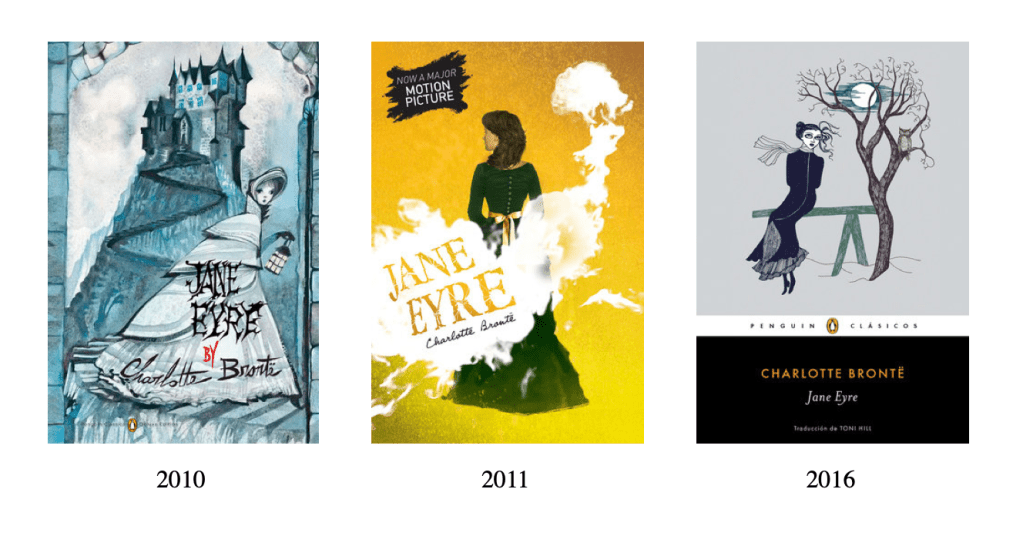
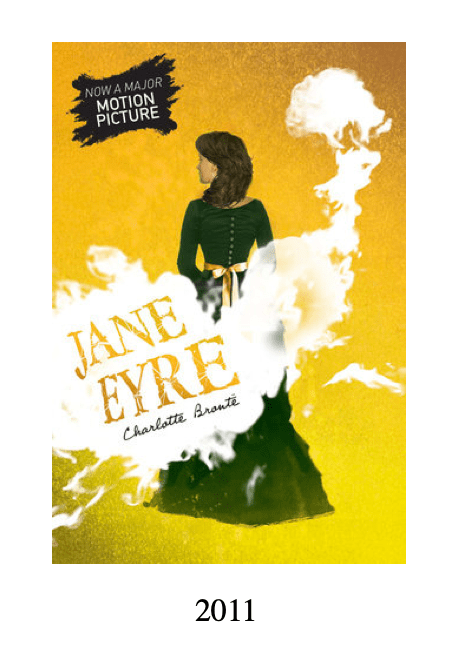
A noticeable shift occurs in 2009 in the Penguin editions: the cover art evolves from portraiture to typography and illustration. There is admittedly a marketing factor at play (i.e., some of these covers exist within a series of classic texts and the 2011 edition promotes the movie adaptation that came out that same year). However, this change in cover art also reveals a shift in the way publishers and readers perceive Brontë’s story. For instance, since 2010, there have been three representations of Jane on the cover (Figure 3). No longer is Jane imagined as occupying domestic space. In the 2010 and 2016 editions, Jane is outside[1]. In this sense, modern marketers give Jane more mobility, as do many modern readers who see Jane as an early feminist.

Figure 4

In addition, these representations are decidedly more Gothic than the portraits examined in the first section of this post, indicating a shift from classifying Jane Eyre as a domestic or romance novel to a Gothic novel. The fog and the fact that viewers cannot see Jane’s face in the 2011 edition hint at the mysterious nature of the tale (Figure 4). Readers cannot see Jane clearly; there is more occurring than meets the eye. The 2010 and 2016 editions include Tim Burton-esque illustrations—an uncanny style that would surely be recognized by readers. In addition, the 2010 publication shows Jane in a subterranean space below Thornfield Hall, which is depicted as both home and castle. Fred Botting contends, “[In Gothic literature] the castle gradually gave way to the old house: as both building and family line, it became the site where fears and anxieties returned in the present” (3). Botting’s assertion is certainly displayed in the novel.Yet, visually, a castle elicits Gothic themes more than an old manor. Jane is in motion, as if hurrying away from Thornfield Hall. The lantern in her hand suggests that it is dark outside. Similarly, the 2016 edition has Jane sitting in the woods at night. These covers ask viewers to consider what is lurking in the shadows—a tactic often employed by modern media with the resurgence of Gothic films and television shows. These covers, then, make Jane Eyre resonant to modern sensibilities.

Figure 5

Aside from these three covers, modern cover art for Jane Eyre is typographic, revealing Jane’s move from a woman in a household to a household name (Figure 5). A text-only approach implies that the title or reputation of the novel is enough to draw reader interest. Discussing the length of novel titles, Moretti contends, “As the number of new novels kept increasing, each of them had inevitably a much smaller window of visibility on the market, and it became vital for a title to catch quickly and effectively the eye of the public” (139). Indeed, we see a shift from images back to text. The title of the novel once more carries the weight.

The background art of these text-only editions (i.e., the 2009, 2012, 2015, and 2020 publications) is worth noting. Three of these four editions include floral backgrounds. While this may be partially related to the style of Penguin’s graphic designers, it is notable that the pattern privileges the natural world over the domestic sphere—once again indicating that modern publishers give Jane agency. Furthermore, the 2015 edition includes a quote underneath the title: “I am no bird; and no net ensnares me; I am a free human being with an independent will.” The publishers decided that this quote represents the novel—a stark contrast to the cover featuring a representation of Jane with Adele and Miss Ingram.

Figure 6

To close, I would like to examine the 2012 edition of the novel (Figure 6). This edition is part of the Penguin Drop Caps series—a series consisting of 26 novels, each representing a different letter of the alphabet. The description of this edition on Penguin’s website states, “‘B’ is for Brontë.” However, “B” also appears to stand for Bertha, especially considering it is paired with an illustration of flames. Bertha famously sets Rochester’s bed on fire in a scene where “tongues of flame darted round the bed” (Brontë 174). Bertha later burns Thornfield Hall to the ground. Considering early editions of the novel focus on domesticity, this choice of cover art is radical. The flames indicate that Brontë’s tale is more than Jane’s story. Modern readers and publishers are hearing marginalized voices, such as that of Bertha, who has been locked away by her husband.

Conclusion

Moretti asks, “How can a couple of words stand in for hundreds of pages? What does it mean, that they should do so?” (145). This post has explored a similar question: How can one image (or lack thereof) represent an entire novel? Moretti details the popularity of female first names as titles in eighteenth-century novels, thus suggesting the protagonist is in want of a surname. He proposes that a last name in a title, such as Jane Eyre, suggests “the marriage plot [was] becoming embedded within genres like the bildungsroman” (147). As this post has detailed, modern readers are interested in more than Jane’s marriage; they are intrigued by the bildungsroman and beyond.

In summary, cover designs indicate what thematic threads in a novel resonate with editors and designers, and thus, presumably, with readers. Closely examining the evolution of Jane Eyre cover art between 1966 and 2020 indicates that publishers’ and readers’ understanding of the novel is expanding. We see covers focusing on Jane in domestic spaces transform into covers where Jane is outdoors or absent entirely. Accordingly, one can infer that modern publishers and readers focus on aspects of the story beyond Jane’s function as a governess or an object of Rochester’s affection; they give Jane more agency and mobility. Indeed, in the typographic covers, Jane has walked off the page entirely.

Works Cited

Botting, Fred. Gothic. Routledge, 1996.

Brontë, Charlotte. Jane Eyre. Penguin Classics, 2006.

Moretti, Franco. “Style, Inc. Reflections on Seven Thousand Titles (British Novels, 1740–1850).” Critical Inquiry, vol. 36, no. 1, 2009, pp. 134–158. 


[1] Unlike the outdoor cover from 1996, Jane does not appear to be at Thornfield Hall, thus signaling her independence.

Categories
The Vampyre

“In Utter Darkness”: Obscurity and Transgression in The Vampyre

By Anthony Wroblewski

There is a particular scene in John Polidori’s The Vampyre that I keep returning to: it is just as Aubrey and Ianthe’s love is blooming—when Lord Ruthven is supposedly disappeared from Aubrey’s life—and what occurs but the onset of a gloomy scene, the scream of a woman, Aubrey’s mortal struggle with a vampire, and the discovery of Ianthe’s death. It is quintessentially Gothic in that, halfway through the story when all seems content, the narrative is upended by spectacular violence and horror. It’s a single, drawn-out paragraph that builds a quickly mounting Gothic atmosphere. It is uncanny (if I may use that unsettled word) as it is “concerned with the strange, weird and mysterious, with a flickering sense of something supernatural,” the dark places where violence and ambiguity overtake (Royle 1). The vampire as a literary figure is itself uncanny, in that it is both alive and dead, man and monster, gentleman and transgressor. That Ianthe’s description of vampires conveys a “pretty accurate description of Lord Ruthven” ambiguates the distinction between the man Aubrey knows and the monster he equates him to, “comingling…the familiar and unfamiliar” (Polidori 10; Royle 1). What I want to do in the following essay, then, is to explore this scene through the lens of Royle’s conception of the uncanny. How does language—specifically through imageries and references to darkness, transgression, and violence—produce a sense of uncanniness in the scene? How might abjection key into the story’s construction of the monstrous vampire? How does the vampire reflect notions of patriarchal control over the body as an object?

In the introduction to his second edition of Gothic, Fred Botting suggests that “darkness, obscurity and barely contained malevolent energy reinforce atmospheres of disorientation and fear” (Botting 4, 2nd ed). Darkness literally produces uneasiness; yet it is the absence of light that is key in this production, as “the interplay of light and dark, positive and negative, is evident in the conventions, settings, characters, devices and effects specific to gothic texts” (3, 2nd ed). In more amorphous terms, darkness is the underbelly of a scene, whether it be in setting or character. These dualities are exemplified by Polidori in Ianthe’s death and the assault of Aubrey. Before departing for his research, Ianthe begs Aubrey to return “ere night allowed the power of these beings [vampires] to be put in action” (11). Ianthe’s anxiety is superstitious, yet the story is titled The Vampyre, and so it signifies an impending transformation that necessarily takes place at night, under the cover of darkness. “Despite the encroachment of horror,” Botting writes, “a wish to know presses curious heroines forward…The use of obscurity, the interplay of light and shadow, and the partial visibility of objects, in semi-darkness…has a similar effect on the imagination” (Botting 6, 2nd ed). In racing home, Aubrey observes that “twilight in these southern climates is almost unknown; immediately the sun sets, night begins” (11). Twilight, being the liminal space between day and night, is not present here. This emphasizes the aesthetic transformation of the scene—foreboding in that its abnormality signifies something sinister and uncanny. As darkness falls, nature becomes an “entangled forest,” “echoing thunders…[and] thick heavy rain” assail him (11). According to Botting, “landscapes stress isolation and wilderness, evoking vulnerability, exposure and insecurity…forests [are] shadowy, impenetrable…Nature appears hostile, untamed and threatening” (Botting 4, 2nd ed). This abrupt transformation acts as a portal into the darknessof the scene to come; it signifies the departure from the light of reason and a hastening towards the messiness of ambiguity. It is as if Aubrey is entering a dream, where some thing is awaiting to be discovered, and in fact, “the dreadful shrieks of a woman mingled with the stifled exultant mockery of a laugh” propels both his and our curiosity to resolve the mystery (Polidori 11). 

Here I want to emphasize the language Botting uses—the production of darkness induces a state of vulnerability, exposure, insecurity; it creates disorientation and fear; it is hostile and threatening. The reason this language is important to this scene in particular is due to what the scene obscures from view. When Aubrey breaks into the lonely hut, “he [finds] himself in utter darkness,” and within that darkness Polidori employs the vampire against Ianthe (11). Unable to reconcile the transgressive nature of this assault, Polidori commits the vampire’s violence towards Ianthe to shadow, instead displacing it onto Aubrey. He is “grappled,” he “struggle[s]…in vain,” the vampire “kneels upon his breast” and “place[s] his hands upon his throat” (12). Citing Samuel Weber, Royle remarks that the “uncanny is a certain undecidability which affects and infects representations, motifs, themes and situations, which…always mean something other than what they are” (Royle 15). We might infer, then, that because the language Polidori uses in Aubrey’s assault is dominating and sexual, and because he obscures the vampire’s assault of Ianthe, that this juxtaposition produces a scene which is an uncanny displacement of a sexual transgression against Ianthe. The ambiguity of what really happens, coupled with the ambiguity of the identity of the vampire, reduces the crimes against Ianthe to mere spectacle, whereas the attack on Aubrey is that uncanny confusion between reality and the fantasy of this supernatural encounter. The moment of discovery, when “the glare of many torches penetrate[s] through the hole that gave light in the day,” mirrors Aubrey’s interruption of the vampire’s crime, the implication being that the resolution of the mystery marks the sexual release of the predator (Polidori 12). This mirroring further confuses the two encounters—of the vampire and Ianthe, and of the vampire and Aubrey—and the presence of a sudden light and the invocation of day, along with the verb to penetrate, suggests a positive violation. This is because light becomes the physical refuge of Aubrey. I think it is safe to say though that, in the case of this reading, it is no refuge. It is, in fact, a representation of a patriarchal tendency to displace the responsibility of the abuser to a point which is away from the crime. By displacing all visible action away from Ianthe and onto Aubrey (who is ultimately rescued), the scene upholds a common sensibility in which women’s bodies become objects of possession for men’s desires.

One of the assertions which Botting makes regarding Gothic transgressions is that “the terrors and horrors of transgression…become a powerful means to reassert the values of society,” and that “transgression, by crossing the social and aesthetic limits, serves to reinforce or underline their value and necessity” (7, 1st ed). He suggests that “after escaping the monsters and penetrating the forest…heroines and readers manage to return with an elevated sense of identity to the solid realties of justice, morality and social order” (7, 1st ed). But where is Ianthe’s justice? Aubrey perceives “the lifeless corse” of his lover, with “no color upon her cheek…[and] upon her neck and breast was blood, and upon her throat were the marks of teeth having opened the vein” (Polidori 12). We are not drawn toward sympathies for Ianthe, but rather towards that object of love which Aubrey has lost through this encounter. Throughout the story she is rendered as “his object [to] attain,” and upon recognizing her death he is “laid by the side of her who had lately been to him the object of so many bright and fairy visions” (10, 12). Her body becomes the object for the transgressions of the vampire’s violence and for Aubrey’s treatment of her as a romantic possession, not an actant pursuing her own designs. Taking a step back to consider the broader themes of The Vampyre, it is apparent that certain social values are being reinforced through the uncanny elements of the narrative. Aubrey characterizes Ruthven as a gentleman; he observes Lord Ruthven and gives his first impression of him as “the hero of a romance,” one who is not only worthy of social observation and study, but who embodies “profuse…liberality” (5). Ruthven’s charities are, on the surface, something to be admired: “when the profligate came to ask something, not to relieve his wants, but to allow him to wallow in his lust, or to sink him still deeper in his iniquity, he was sent away with rich charity” (6). Yet these boons have “a curse upon [them], for they (recipients) all were either led to the scaffold, or sunk to the lowest and the most abject misery” (6). His sexual escapades with women are painted as transgressive; however, it is those “female hunters after notoriety attempt[ing] to win his affections” who are blamable (3). Women in general are relegated to the space of objects, and the subject Ruthven becomes those “fears of social disintegration…enable[ing] the reconstitution of limits and boundaries. Good [is] affirmed in the contrast with evil; light and reason [win] out over darkness and superstition” (Botting 8, 1st ed). Ruthven is not a good person, but neither are the women whom he encounters as represented by Aubrey. This is because the social order of the day is specifically prohibitive of liberality, and violent death is the uncanny consequence of transgressing these boundaries. But Ianthe is notlike these other women—in fact she is described as being an “unconscious girl,” embodying “innocence, youth, and beauty” while being “fairy” and “infantile” (Polidori 9-10). She is the good feminine—that which adheres to the social structures around her—and as a result, the depravity of the vampire must destroy her. 

Ruthven as the vampire transgresses multiple social boundaries leading up to Ianthe’s murder, and the transgressive nature of the vampire as an instrument of sexual violence serves to reproduce patriarchal social norms which objectify women’s bodies as possessable. Aubrey is complicit in this construct, as his reinforcement of the angel/whore dichotomy, as well as his objectification of Ianthe, support these social norms. Those women who exercise sexual freedom are shunned, while those gentlemen who exercise it are lauded as romantic heroes. The lonely hut as a domestic space is infiltrated by the vampire, who represents both stranger and familiar. Passionate violence towards Aubrey displaces sexual violence against Ianthe. While the uncanny disintegration of social boundaries within The Vampyre produce horrifying monsters out of liberality, they simultaneously reinforce the rigidity of patriarchal structures of social, sexual, &c conservatism. And the stage for which anxieties regarding the fluidity of social boundaries is set within the obscuring darkness, so that that which is transgressive takes on the monstrous, the uncanny. 

Works Cited

Botting, Fred. “Introduction: Gothic Excess and Transgressions.” Gothic. Routledge, 1996, pp. 1-20.

—. “Introduction: Negative Aesthetics.” Gothic. Routledge, 2014, pp. 1-19.

Polidori, John. “The Vampyre.” The Vampyre and Other Tales of the Macabre. Oxford University Press, 2008, pp. 1-24.

Royle, Nicholas. “The Uncanny: An Introduction.” The Uncanny. Routledge, 2003, pp. 1-38.

Categories
Northanger Abbey

NORTHANGER ABBEY AND THE ABJECT: READING ISABELLA THORPE

By Cali Mellin

Fig. 1. Cover of Northanger Abbey. Austen, Jane. The Annotated Northanger Abbey, edited by David M. Shapard. Knopf Doubleday Publishing Group, 2013, front cover.

In Jane Austen’s Northanger Abbey, she provides a satirical critique of the unsavory and excessive elements of the Gothic by following the maturation of her own “heroine,” Catherine Morland. Catherine is immersed in the uncanny through texts such as Mysteries of Udolpho and The Monk, and she is brought along on this adventure by her new companion Isabella Thorpe. Isabella, depicted as absorbed, shallow, avaricious, and unrestrained, receives little sympathy from the narrator. What the audience finds in Isabella, though, is Austen’s most explicit critique of the Gothic. Isabella embodies the uncanny, excess, and homoeroticism that is characteristic of Gothic anti-heroes. Northanger Abbey demonizes these traits in Isabella’s character, even though they are also present in the novel’s heroine. Thus, Isabella stands for abject aspects of Catherine’s character. As Jerrold E. Hogle explains in her article about abjection and the Gothic, “In abjection the most multifarious, inconsistent, and conflicted aspects of our beings are ‘thrown off’ onto seemingly repulsive monsters or ghosts that both obscure and reveal this ‘otherness’ from our preferred selves that actually exists very much within ourselves” (498, emphasis in original). Rather than creating a ghost or a monster, Austen instead draws an unlikeable character to “obscure and reveal” the unsavory elements of her Gothic heroine. Although Catherine undergoes a test of character that results in her own maturation, by the end of the novel Isabella remains a reminder of the danger and repulsiveness of different aspects of the Gothic. Through a close reading of Isabella’s letter to Catherine, as well as Catherine’s response, I will demonstrate the way that Isabella embodies Gothic traits such as the uncanny, excess, as well as homoeroticism, and how Catherine casts such characteristics off in order to make Isabella her abject self.

It is in Isabella’s inconsistency that we find the uncanny most indisputably represented. Isabella expresses her avarice and ambivalence to James Morland after learning that his wealth is considerably less than she first imagined. She writes to Catherine, though, “I am quite uneasy about your dear brother, not having heard from him since he went to Oxford; and am fearful of some misunderstanding . . . he is the only man I ever did or could love, and I trust you will convince him of it” (203). Not only does the audience recognize the difference between Isabella’s words and her actions, Catherine sees this as well: “[The letter’s] inconsistencies, contradictions, and falsehood, struck her from the very first” (204). Isabella’s deceit has the effects of uncanniness; she becomes something both familiar and unfamiliar to Catherine, who recognizes her attitude and manner of speaking but not the events or emotions contained within the letter. In Nicholas Royle’s introduction to The Uncanny, he writes, “The unfamiliar, in other words, is never fixed, but constantly altering. The uncanny is (the) unsettling (of itself)” (5). The specific use of the words “inconsistencies” and “contradictions” is particularly indicative of the uncanny. It is not simply a lie that Isabella tells, but it is a narrative that is unfixed and that alters. Isabella spins narratives for Catherine that are not only untrue but change as she speaks and writes them. Earlier in the novel, when Isabella discusses John’s affection for Catherine and whether Catherine returns these feelings, Catherine exclaims, “But my opinion of your brother never did alter; it was always the same. You are describing what never happened” (138). This unsettling of narrative and truth is off-putting for Catherine and the reader. While the uncanny and its uncertainty is used as enticement and excitement for readers of the Gothic, Austen demonstrates in Northanger Abbey how its presence in reality is not only off-putting but also morally corrupt. After reading the letter that Catherine finds to be a fiction, Catherine tells Henry Tilney, “I wish I had never known her” (204). The separation which culminates in Catherine never returning Isabella’s letter is not simply an act of abjection—Catherine’s attempt to throw off repulsive attributes that may be present in herself—it also acts a punishment to Isabella for her deceit. Thus, Catherine rejects Isabella for her uncanniness that she shows through inconsistency of character.

Isabella is not only punished for her uncanniness but also for her indulgence in excess. Isabella writes to Catherine that she received her letters “with the greatest delight” and owes Catherine “a thousand apologies” because she is “quite ashamed” for her lack of response (202, emphasis added). This superfluity of language continues when she describes Bath as “horrid” and rejoices, “Thank God! we leave this vile place to-morrow,” complains that “every body one cares for is gone,” and writes of James that “he is the only man [she] ever did or could love” (202). Isabella relies heavily on exaggeration and an excess of emotion that Catherine criticizes as “disgusting” after having read the letter (204). This is a noteworthy response as Catherine herself reacts to the letter in a manner that is exaggerated and excessively emotional, exclaiming, “So much for Isabella . . . and for all our intimacy . . .! I wish I had never known her” (204). Thus, we see Catherine explicitly condemn a characteristic that she herself has and that is associated with the Gothic. Fred Botting explains in his introduction to Gothic, “Gothic excesses transgressed the proper limits of aesthetic as well as social order in the overflow of emotions that undermined boundaries of life and fiction, fantasy and reality” (4). Catherine repeatedly falls into this trap of letting her imagination create grand and excessive emotional responses within herself. Most notably, Catherine believes that General Tilney has murdered his wife, and after her attempts to investigate this, her emotions spiral: “[S]he ran for safety in her own room, and, locking herself in, believed that she should never have the courage to go down again. She remained there at least an hour, in the greatest agitation, deeply commiserating the state of her poor friend . . . at last . . . she was emboldened to meet [General Tilney] under the protection of visitors” (181). Catherine’s depth of feeling is expansive as she worries about General Tilney’s reaction to both herself and to Eleanor. She suffers from the “greatest agitation” and “deeply commiserate[es]” with Eleanor. Her fear causes her to literally run and hide for “at least an hour,” and she must muster up her courage in order to face General Tilney again. We see Catherine reprimanded for this behavior only a few pages later by Henry, and she largely grows out of this indulgence of excessive emotion by the end of the novel. Isabella, in contrast, does not grow out of her affinity for excess, and so again we see that by rejecting Isabella, Catherine and Northanger Abbey to condemn unpleasant and immoral behavior.

The final aspect of herself that Catherine must throw off is homoeroticism. In an effort to correct the homosexual feelings that Catherine holds for Isabella, she must ultimately end their relationship. Moments of romantic expressions of love emerge between Catherine and Isabella throughout the course of the novel, and this is visible in Isabella’s letter as well. After Isabella has expressed her disdain for being stuck in Bath, she writes to Catherine, “I believe if I could see you I should not mind the rest, for you are dearer to me than any body can conceive” (202). As already mentioned, Isabella has an affinity for exaggeration and speaking in excessive terms, and thus on its own, Isabella’s statement could simply be read as exaggeration, but read in the context of “if I could see you I should not mind the rest,” it seems to suggest that Catherine is a sort of refuge for Isabella in her current circumstances. The idea that Isabella’s love is something that no one “can conceive” also has clear homoerotic implications; the attraction and affection between Isabella and Catherine is not simply a platonic emotion, rather it something that is not immediately recognizable or acknowledged in their current society or reality. Isabella talks about Catherine with far more emotion than she does when speaking of James Morland, and even when she discusses her love for James, Catherine is implicated in this as well, for John is “the only man [Isabella] did or could ever love, and [she] trust[s] [Catherine] will convince him of it” (203). Catherine, who knows what Isabella’s love feels and looks like, is the only one who could convince James because she is the only one who has ever experienced it.

We see Catherine feel an attraction to Isabella as well. Catherine meets Isabella after Henry fails to make an appearance at the pump-room. The two women become fast friends, and Isabella asks Catherine to “take a turn with her about the room. Catherine was delighted with this extension of her Bath acquaintance, and almost forgot Mr. Tilney while she talked to Miss Thorpe. Friendship is certainly the finest balm for the pangs of disappointed love” (32). This friendship quickly turns to “admiration,” “delight,” “awe,” and “tender affection” (32). Catherine is a sort of refuge for Isabella, and Isabella evokes strong attachment in Catherine—in fact, much more than Henry Tilney first evokes in her. The most Catherine feels because of him is “high luck” (27) and fear “that he indulged himself a little too much with the foibles of other” (29). In comparison to her first meeting with Henry, the response of “tender affection” stirred by Isabella is far more intense. We then read “the finest balm for the pangs of disappointed love” as something sardonic and understand that rather than a balm, Isabella is something far more interesting and enticing to Catherine—something that causes her to forget Henry almost entirely.

After this meeting, Catherine “ran directly up stairs, and watched Miss Thorpe’s progress down the street from the drawing-room window; admired the graceful spirit of her walk, the fashionable air of her figure and dress, and felt grateful, as well she might, for the chance which had procured her such a friend” (33). Catherine clearly feels drawn to Isabella—attracted even, in the way that she watches Isabella, her “figure,” and the “graceful spirit of her walk.” Even more, describing Isabella as “such a friend” implies a certain amount of specificity; there is a difference between Catherine’s relationship to Isabella than the other girls or women that she might befriend. Even more, when Catherine does cast off Isabella, she explicitly states that she “was ashamed of Isabella, and ashamed of ever loving her” (204). The distinction between these two statements is important: Catherine is not only ashamed of who Isabella is, but she is also ashamed of her own attachment to Isabella. Catherine is implicated not only in Isabella’s actions but her feelings as well. Isabella’s affection creates disgust in Catherine now, and Catherine’s own love for her is something shameful. Ultimately, Isabella is made to represent homoeroticism through her abjection. Catherine is absolved of her culpability of this homoeroticism, as she is for her fascination with the uncanny and excess as well.

By making Isabella an abjection of punishable Gothic tropes, Northanger Abbey is able to parody, critique, and employ elements of Gothic literature. Although Gothic tropes, such as the uncanny, excess, and homoeroticism, may make for enticing and enjoyable literature, Northanger Abbey demonstrates that these tropes should not extend past the realms of fiction. Through manufacturing Isabella as an abjection, though, Northanger Abbey creates an antagonist that does not parody but rather upholds Gothic tradition. Northanger Abbey fails to create Isabella as a wholly unsympathetic character—her own position in society is too fragile. Rather than a man with great wealth and a high station who acts out of pure selfishness and desire, Isabella is young woman whose only method for survival is marrying well. Her own motivations then, while still selfish, have an added layer of necessity. Although readers may find her character and actions distasteful, her own precariousness is undeniable. Rather than having fashioned an irredeemable monster, then, Austen writes a complex antagonist who still invokes sympathy from her audience. This is solidified further by the ambiguity of Isabella’s fate. We do not hear again from or about Isabella after Catherine reads and scorns her letter. Though Catherine punishes Isabella with abjection, her open-ended outcome indicates some benevolence from Austen. Readers do not learn that she married poorly, unhappily, or not at all, and so there remains optimism that Isabella may be able to survive regardless of her actions and the insecurity of her situation. Thus, though we certainly read Isabella as an antagonist, she is not an unequivocally evil or terrible character. Rather, like we frequently see in Gothic texts, her character is layered, multifaceted, and even uncanny. In an attempt to ridicule and chastise Gothic tropes, Northanger Abbey produces its own Gothic villain that is used to redirect Catherine’s desire into accepted heterosexual channels and to define her heroinism as characterized by honesty and carefully regulated emotion. However, ultimately, Isabella (who embodies all that the heroine must not be) is not entirely thrown off—in fact, she lives on as a reminder of a kind of rebellious, uncontained feminine identity.

Works Cited

Austen, Jane. Northanger Abbey. Penguin, 2003.

Hogle, Jerrold E. “The Gothic Ghost of the Counterfeit and the Process of Abjection.” In A New Companion to the Gothic edited by David Punter. Blackwell, 2012.

“Introduction: Gothic Excess and Transgression.” In Gothic: The New Critical Idiom by Fred Botting. Routledge, 1995.

“The Uncanny: An Introduction.” In The Uncanny by Nicholas Royle. Routledge, 2003.

Categories
Northanger Abbey

Too Many Novels? Northanger Abbey and the Gothic Novel

By Theresa Endris

Jane Austen’s Northanger Abbey, written when Gothic novels were extremely popular and widespread, seems neither conformed to nor yet totally separate from the genre. Margaret Thomas opens her essay on “Northanger Abbey and the Gothic Romance” with a statement from the Oxford Companion to English, saying that the novel’s commonly identified purpose is to “ridicule the popular tales of romance and terror, such as Mrs. Radcliffe’s The Mysteries of Udolpho, and to contrast with these the normal realities of life” (Thomas). Austen’s choice of narrative style and her explicit opinions slipped in between the storyline are no doubt very intentional in creating a satiric commentary on the Gothic novels of the time, comparing her unextraordinary heroine Catherine Morland with the commonly known tropes of delicate, long suffering, tragic female characters. Between Northanger Abbey and The Mysteries of Udolpho alone, one can see many explicit parallels. By so intentionally opposing Catherine’s qualities and familial background to Mrs. Radcliffe’s Emily, Austen’s novel hardly appears to produce a “promising” heroine, which the author-as-narrator herself humorously acknowledges. Yet, the reader is made to have an expectation of an adventure of sorts, which will prove Catherine indeed to be a heroine of some consequence. Adventures of the common variety are plentiful enough, and dominate the majority of the novel: her trip to Bath at the expense of a good-natured, but uninteresting couple, her first encounter with romantic attachment, the thrill of novel-reading with a charming and witty friend, and the attentions of a flattering, but boastful and inept man. It is not until Catherine is invited to stay at Northanger Abbey and later is dramatically turned out that she fulfills the definition of heroine which Austen has been setting up her readership to expect. While Northanger Abbey appears largely to be a critique of Gothic drama and excess which ought not be placed above good sense, Catherine’s misadventure proves to be an exceptional moment when her intuitions, schooled by excessive reading of Gothic novels, are startlingly accurate.

            Catherine Morland’s greatest vice, it would seem, is in novel reading. After all, it is her fevered imagination that gets her into the most trouble. Yet in a highly humorous and ironical passage about novel readers and their writers, Austen makes it known that in purposely having her own heroine be in the habit of reading novels, she is critiquing her fellow writers who cater to the opinions of their worst critics. Since they stage their own heroines as disgusted with novels, or ashamed if they betray an interest, such writers undermine the value of their own novels. Austen points out that there is nothing to be ashamed of, since novels are meritorious in their entertainment and art, where “the greatest powers of the mind are displayed,” affording “the most thorough knowledge of human nature, the happiest delineation of its varieties,” and “the liveliest effusions of wit and humor are conveyed to the world in the best chosen language” (37). At this moment in the narrative, we have not known any harm of Catherine’s voracious appetite for Gothic reading. It would seem that her perusals of them with Isabella are innocent and stimulating, and “sensible” reading such as Sir Charles Grandison, an older novel of historical fiction, is posed as dull and uninteresting. Isabella’s declaration that the work is “an amazing horrid book,” (40) which her friend Miss Andrews could not bring herself to finish, echoes Austen’s comment on the apparently sensible reading of the Spectator: “the substance of its papers so often consisting in the statement of improbable circumstances, unnatural characters, and topics of conversation…and their language, too, frequently so coarse as to give no very favourable idea of the age that could endure it” (37). Yet Austen is no Isabella, and Sir Charles Grandison is a novel of a certain kind which she might well have approved of, while the Spectator was a periodical published by politicians that commented on news, manners, morals, and literature (The British Library). Of novels Austen is fond, but clearly all novels are not created equally—and with that, neither are their readers, heroines or otherwise.

Ironically in concord with the opinions of novel critics that Austen has just denounced, Catherine’s preferment of fictional fancy over sensible works is shown to be a detriment in some capacity; it leads her to make embarrassing surmises during her stay at Northanger Abbey, most of which she privately chastises herself for, but eventually injure her in the eyes of her romantic interest, Henry Tilney. While she and Tilney enjoy a lively and teasing conversation about Northanger Abbey’s potential secrets just before their arrival, Catherine’s interest is too much excited for her to fully feel it only in jest: “Catherine, recollecting herself, grew ashamed of her eagerness, and began earnestly to assure him that her attention had been fixed without the smallest apprehension of really meeting with what he related” (152). Contrary to what she tells Tilney, her imagination is certainly stirred up, and results in her actively seeking out mysteries and terrors which are not there. Far from sensational and dramatic for the majority of the narrative, Northanger Abbey suddenly takes on the atmosphere of a Gothic novel, when the readers are privy to Catherine’s nervous thoughts and curiosity, especially one night when she loses half of her night’s rest over her discovery of a mysterious cabinet appearing to be made of ebony. Sense returns with the daylight when its contents turn out to be nothing more than an old washing-bill left there by mistake. Although during the day Catherine’s imagination is more subdued, it is not inactive, since, after all, her surroundings are endowed with recognizable Gothic elements. However, Catherine’s tour reveals that its owners have done much to improve Northanger Abbey for modern comforts, disappointing her romantic sensibilities: “Catherine could have raved at the hand which had swept away what must have been beyond the value of all the rest, for the purposes of mere domestic economy” (174). She imagines all she can in spite of the modernity, hardly able to “overcome the suspicion of there being many chambers secreted” (173).

Fig. 1. Henry Tilney teases Catherine by telling tales about the chambers in Northanger Abbey, and Catherine imagines scenes similar to those of a Gothic novel. C.E. Brock color illustration from 1922 edition of Northanger Abbey. Publisher: J.M. Dent, London.

Perhaps these imaginings would have remained harmless, had the circumstances been different, but Catherine’s schooling in the Gothic novel has not only informed her intuitions about rooms and objects, but about character dispositions as well. General Tilney’s contradictory traits catch her attention, and her knowledge of Henry and Eleanor make her astonished at the General’s stern treatment of them, since to her he is all kindness. She soon believes that there must be some terrible secret that the General is keeping relating to his deceased wife, since his behavior is the most disturbing when Eleanor tries to show Catherine her mother’s chamber: “The General’s evident desire of preventing such an examination was an additional stimulant. Something was certainly to be concealed; her fancy, though it had trespassed lately once or twice, could not mislead her here” (175). Not only does the General prevent them, he is quite angry about it, for no obvious reason. The oddity of the circumstances parallel Gothic mysteriousness for Catherine, and for the reader as well. Had Catherine not been reading Gothic novels, perhaps she would have noted disturbing qualities in the General’s behavior, but would not have drawn conclusions which prove later to be somewhat accurate. Nonetheless embarrassment and shame result when her conjectures overstep reasonable bounds in her believing the General to have either shut up or murdered his wife. She does not say it in so many words to Henry Tilney, who catches her by surprise when she is leaving his mother’s private chamber, but the suggestion of the General’s possible neglect or cruelty towards her in illness is enough to scandalize Henry: “And from these circumstances…you infer perhaps the probability of some negligence…or it may be—of something still less pardonable” (185). His reproach “What have you been judging from? Remember the country and the age in which we live. Remember that we are English, that we are Christians. Consult your own understanding, your own sense of the probable, your own observation of what is passing around you” (186) Catherine finds a death to her fancies.

Fig. 2. Catherine is taken by surprise by Henry Tilney. C.E. Brock color illustration from 1922 edition of Northanger Abbey. Publisher: J.M. Dent, London.

Catherine realizes that, charming as novels such as Mrs. Radcliffe’s are, “it was not in them perhaps that human nature, at least in the midland countries of England, was to be looked for” (188). However, in this conclusion it is not clear whether these are the author’s opinions, or merely Catherine’s, colored by her experiences. Over a hundred pages prior Austen declares that novels provide “the most thorough knowledge of human nature, the happiest delineation of its varieties” (37), and Henry Tilney later that “[t]he person, be it gentleman or lady, who has not pleasure in a good novel, must be intolerably stupid” (102). John Thorpe comes to mind, since he never reads novels. It would seem, then, that character dispositions and educational background have more to do with how much good a novel can do, than anything else. Henry and Eleanor do not only read Mrs. Radcliffe; they read and enjoy history and other “sensible” works, which prevent their imaginations from running away with them. At the same time, they can appreciate the legitimate truths about human nature that even Gothic novels embody, while enjoying their thrills.

Catherine’s sensibleness increases in the company of Henry and Eleanor, but her unexplained turning out of Northanger Abbey is undoubtedly an extraordinary and abnormal event. Disenchanted by this time, Catherine does not spin outrageous fantasies to explain the General’s motives, but when everything is revealed at the end by Henry, Catherine’s original conjectures about his characters no longer seem so far off the mark: “Catherine, at any rate, heard enough to feel, that in suspecting General Tilney of either murdering or shutting up his wife, she had scarcely sinned against his character, or magnified his cruelty” (230). This is an extraordinary concession. Though Henry earlier bade Catherine to think of the Christian, English society they live in before admitting such awful suspicions, the General does act inhumanly and cruelly, against Christian charity, and not only to Catherine, but also to his children. Though Gothic novels are perhaps not best suited to be the only guide to human nature, they reveal truths about the “real” world at the most unexpected moments, and Austen knew enough about them to allow for it.

Northanger Abbey, while not entirely a Gothic novel itself, experiments with its tropes and imagery by introducing an unusual set of circumstances for its relatively unextraordinary heroine to grapple with. It is an ironic work in that, while appearing to disapprove of too much indulgence in Gothic novels, also acknowledges their merit as part of the growing body of novels. Austen herself does not write her subsequent novels in the style of the Gothic, but something closer to the ideal she expresses at the beginning of Northanger Abbey, filled with characters of the most lively variety that nature can produce: certainly the most ridiculous, wanton, and cruel, but also the most sensible and witty. The commonality of life holds adventure enough, and what better place to examine it, make sport of it, and plumb its depths than in a good novel?

Works Cited and Further Reading

Austen, Jane, and Marilyn Butler. Northanger Abbey. Penguin, 2003.

Hudson, John. “Gothic, romance and satire in Northanger Abbey.” The English Review, vol. 12, no. 1, 2001, p. 21. Gale Literature Resource Center, https://link-gale-com.ezproxy.stthomas.edu/apps/doc/A79411075/LitRC?u=clic_stthomas&sid=LitRC&xid=3c3141c6. Accessed 27 Feb. 2020.

“The Spectator.” The British Library, http://www.bl.uk/learning/timeline/item126933.html.

Thomas, Margaret. “Northanger Abbey and the Gothic romance: Margaret Thomas explores the relationship between sense and sensationalism in Jane Austen’s novel.” The English Review, vol. 21, no. 4, 2011, p. 35. Gale General OneFile, https://link-gale-com.ezproxy.stthomas.edu/apps/doc/A252002876/ITOF?u=clic_stthomas&sid=ITOF&xid=5bfce547. Accessed 27 Feb. 2020.

Design a site like this with WordPress.com
Get started